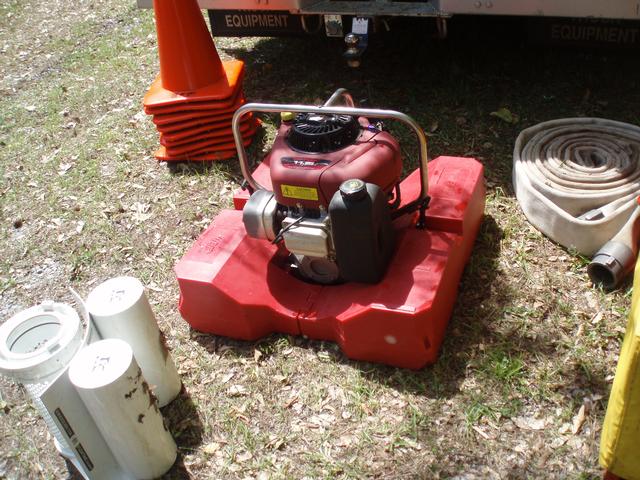
Many rural fire departments have portable or floating pumps lying around. During our visit to Shelby County, Alabama last year we tried a few ideas:
Extend access to water supplies:
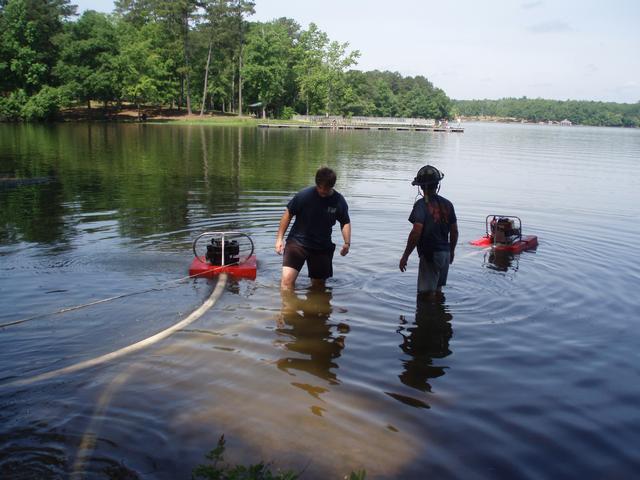
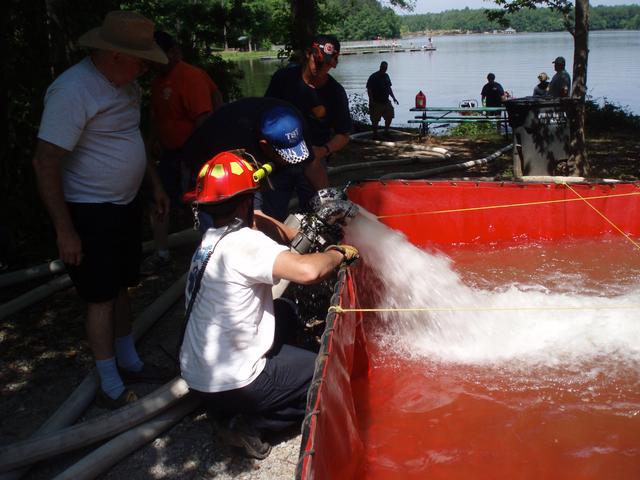
A lot of folks have ponds and lakes available but can't get close enough to throw a hard sleeve into them. A portable pump (or two) feeding a porta tank can provide 250 (or more) gpm into your porta tank and then you simply draft out of the porta tank. Using the porta tank as the "middle man" enables you to store water when you aren't using it and have it ready to use when a larger flow is called for. So let's say you are filling tankers – if the average time between tankers is 5 minutes – you can store 1250 gallons with one 250 gpm pump or 2500 with two gpm pumps. So that 250 gpm portable pump that looks like it's only useful for brush fires, when combined with a portable tank, all of a sudden becomes a much more powerful tool.
If you don't have the adaptors to have the portable pump dump directly into the folda tank you can connect it directly to one of your intakes. Then connect your hard sleeves to the other intake and open both valves. When you are only flowing your circulating line, the unused water from the portable pump will go out the hard sleeve and fill your folda tank. When you increase your flow/discharge at your pumper (as in filling a tanker) the flow in the hard sleeve will reverse and you will be able to draft your capacity – and probably a little bit more.
Priming hard sleeves:
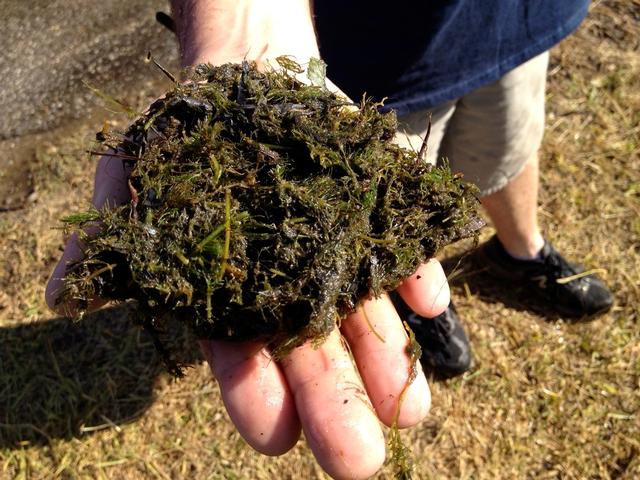
Another maneuver that was tried was laying out 50' of hard sleeves to the lake and priming the hard sleeves by flowing the water from the portable pump through the other intake and out the hard sleeves. This did not work well but was probably due to the fact that by this point in the drill we had sucked up a ton of hydrilla and had blocked the intake that the portable pump was feeding.
Some tips with using portable pumps:
1. If you are going to rely upon them for extended operations make sure that you have plenty of fuel.
2. Portable pumps are a low pressure proposition. Don't be afraid to use LDH to minimize your friction loss. (250 gpm through 2.5" hose is 12 psi per 100, using 4 inch reduces the friction loss to essentially 1 psi per 100).
3. Portable pumps need to be started with air in them. If they have already been primed, it's going to be tough to get them started.
4. If you connect a portable pump directly up to your intake, check your intake screens, especially if you lose flow - they could be clogged.
5. Tie off your portable pump so you don't lose it; they can be self-propelled if your hoseline breaks. |