Got Big Water

YouTube
YouTube Channel

Facebook
Facebook Page

Twitter
Twitter Page

Rural Water Supply Operations Seminar

Water Supply Officer Seminar

Relay Pumping With Large Diameter Hose

Dry Fire Hydrants Seminar

Dry Fire Hydrant Designs and Installations

Web Counters
Website Visitors
Since
June 22, 2009
3,960,650
Visitors Today
Nov 18, 2026
1,170


Official PayPal Seal

Dry Fire Hydrant Design 06 - Securing a Suction Strainer

Print this story (opens in a new tab)News RSS feed (opens in a new tab)Share on Facebook (opens in a new window)Share on X (opens in a new window)Add a comment

By President Mark Davis
October 20, 2016

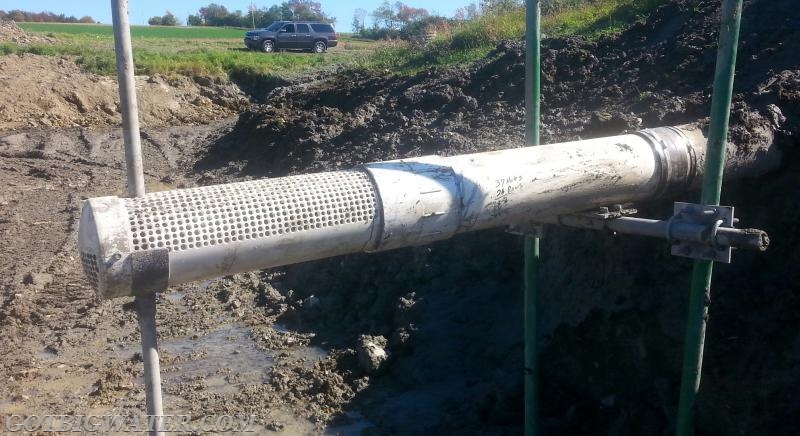
When installing a dry fire hydrant in a pond, one concern is the need to anchor the suction strainer. When the pipe does not run out into the pond very far (say less than 10-ft from the shoreline), then the need to secure the strainer is not that critical. However, as the length of pipe in the water increases, then the need to secure the strainer increases as well. When using PVC pipe, the issue is floatation. When the pump operator back flushes the dry fire hydrant before using it, a large plug of air will move through the pipe from the suction head to the suction strainer giving buoyancy to the system. Thus, securing long lengths of pipe and the suction strainer is important.

The suction head shown in this photo is secured and supported using designed support points. (Photo provided by Member Harry Harty).


Website Designed and Hosted By: Content Proudly Maintained By: Contact Info:
Firehouse Solutions
www.FirehouseSolutions.com
GBW Associates, LLC
3178 Cardinal Drive
Westminster, MD 21157

Emergency Dial 911
Phone: 443-398-6619
E-mail: thebigcamel@gotbigwater.com
Copyright © 2026 Firehouse Solutions (A Service of Technology Reflections, Inc.)