|
|
||
The Night Before I.S.O. |
| By Member Charles Clark | |
| January 4, 2012 | |
Twas the night before Christmas...I mean the night before our I.S.O. inspection I remember dreaming someone saying, "...40% of your I.S.O. rating is your water supply -How likely are you to meet the fire flow demand for a specific fire exposure." It was that intimidating I.S.O. Inspector. He went around our community and picked our several of our largest buildings. He drilled us on how we have planned or demonstrated how to handle that fire flow need. He said, "...250 GPM is not easy; 500GPM takes work; 750 GPM is a big accomplishment; and 1,000 GPM is awesome -I want to see awesome!" I have selected the Mulch Production Plant for your mock fire site." "You have a fire with a needed fire flow of 1,000 GPM. The nearest hydrant is 1 mile away (it flows 500 GPM). How do you plan to get 1,000 GPM to the fire?" The inspector followed up: "...By the way... your run reports only show an average of 8 people per fire run. You may only use 8 people from your department for this drill." He had a wide grin spread across his face as he added, "Lets get real...you need a miminum of 6 people to fight the fire (pumper operator; 2 in; 2 out; and O.I.C./safety officer). Now you only have two people available to supply water..." I began to get a panicky pain in my stomach like when the tone drops. I though to myself: There's no way you can haul 1,000 GPM to a fire with two people. I began to run the following calculations in my mind:
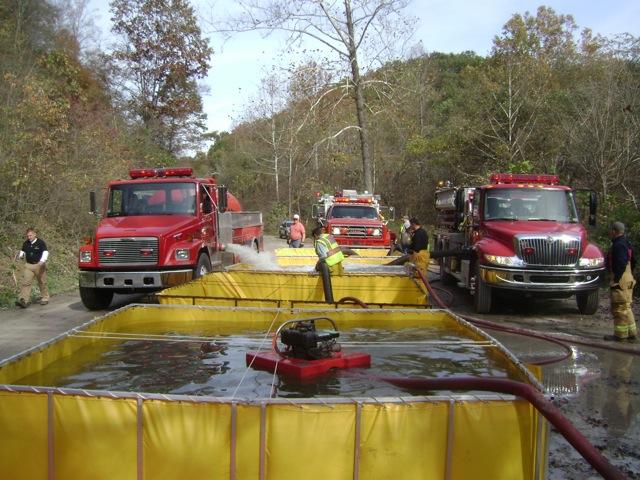
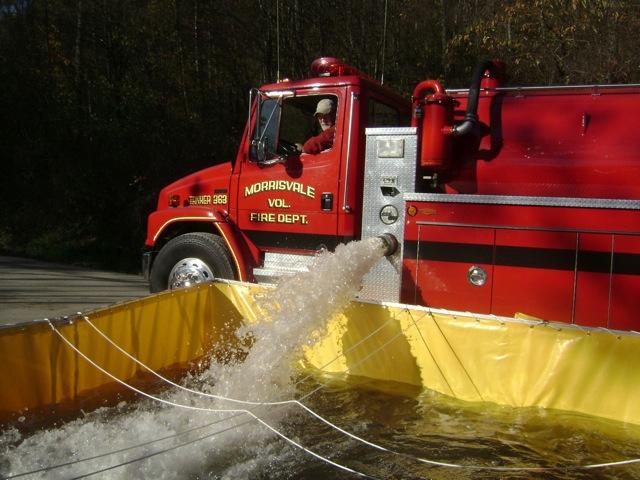
As if he could read my mind that I.S.O. inspector taunted: "By the way...that new pumper you just purchased...if you use it to fill tankers and not attack fire...park it in the barn...that $250,000 you just spent won't count toward your total fire flow pumping capacity..." That Grinch was trying to steal our Christmas! The Inspector sounded like a proscuting attorney at a trial when he badgered: "How do you deliver 1,000 GPM using only 2 people from your department?" I felt like saying "There's no way...Now go away like the ghost from I.S.O. past..." I held my tongue because I knew we had to jump through whatever hoop they put out in front of us. Without hesitating our fire chief blurted out, "We'd call for tankers and man power from four neighboring departments. As my nightmare continued on, three out of the four departments responded with two people on each tanker. We needed one person from each tanker to pack up and replace our interior fire fighters. That left 6 people to use four tankers to deliver 1,000 GPM -by this time it's an exterior defensive attack. Does this sound familiar? By the way, the 6 water supply people were like me -older department members who "only drive tankers" -they are not up to the strenuous fire fighting. Finally the tanker "task force" headed for the hydrant. The net flow of the 500 GPM hydrant was only 350 GPM when you figure the down time for hooking and unhooking the tankers etc. We're only 650 GPM short of having enough water to supress the fire. We will have several hours to demonstrate our heroics to our neighbors. We'll all have time to spray water wich is our reward for being on the department. I didn't get to spray water because someone said that they thought that there was a hole of water under the bridge not far from the fire. We took our tanker to check out the possible water source. Well, there was a hole of water but it was at least 10 ft. below the bridge and the creek banks were too steep to climb. There was no way we could climb down that bank carrying that heavy floating pump--two of us struggled to carry the pump on level ground. We decided to take ropes and hoist the pump down to the water's surface. We got it half way down and when we remembered that we had to have the pump started before putting it in the water. We mustered all available strength to pull the pump back up. We started the pump and lowered it down to the water. OOPS! It started pumping water. How do we shut down the line? Where's that hose clamp that I.S.O. says should be on the trucks? It's on the other truck--never where you need it! Both of us tried standing on the hose since the pump was a low pressure pump. The other guys struggled to hook up the hose. They got soaked. It took 10 minutes to fill the tanker. Not bad for a pump capble of 400 GPM max. We heard excited words on the radio to the effect: "...More water!...We're out of water!..." We felt like telling the O.I.C. that if he wanted water any quicker he can come get the water himself. Now between the hydrant and the floating pump we were filling tankers at 650 GPM -only 350 GPM more to meet our needs. Someone else came up with another floating pump. We let them have the pleasure of hoisting the pump over the guard rail. What a sight! Oh the fun of rural fire water supply. At 300 GPM we were still 50 GPM short. Someone finally noticed that there was a well with a hand pump within 100 ft. of the burning structure. That mouthy O.I.C. guy found a few buckets at the scene and invited some of the "standbyers" to have some fun. I think they threw more water on each other than on the fire. After about an hour we looked down the road and saw a cloud of dust rolling into the sky from a strang looking convoy. It was led by a unit with a bright red flashing light. The dust cloud finally cleared away and we saw some funky looking red trucks with round red tanks. This no longer seemed like a dream. It seemed real! The first truck said Morrisvale Vol FD, Boone County, West Virginia. Out stepped one of the nicest individuals I had ever met. It was Chief Doug Estep. I told him about the Ghost of I.S.O. present....I mean the I.S.O. Inpsecctor's demand to move 1,000 GPM with only a handful of people and just a few trucks. Chief Estep said, "That's no problem...we do that all the time." It turned out that those funky looking red trucks with round red tanks were vacuum tankers. They proceeded to deliver 1,000 GPM with just five vacuum tankers and one conventional tanker. Four of the tankers were 2,000 gal. one was 3,500 gal. and the conventinal tanker was 2,500 gal. They made it look so easy! They put a dump tank at the hydrant to let the hydrant continuously flow at 500 GPM. They were able to let the dump tank refill while waiting for the next tanker to return to refill. Those tankers sucked up 1,333 GPM and dumped at 2,000 GPM. Our floating pumps had run out of gas and we were too tired to pull them back up to refuel. The elves...I mean the heroes from Morrisvale slid their 6 inch suction hoses under the guard rails on the bridge with the floating strainer attached to the end. Before we knew it they were filling the tankers from the stream at about 1,000 GPM. This was all done with one person per tanker and no pumpers. We were amazed! To the I.S.O. Inpsector's surprise we were able to deliver 1,000 GPM with only a handful of people and very few trucks. Could I still be dreaming or is this really possible? The I.S.O. Inspector gave the vacuum tankers a score of 100% and the conventional tanker could only score 90% at best. When I awoke the next day I rushed out to convince our department to buy a new vacuum tanker before Firovac got swamped with orders. On my way home I ran into the I.S.O. Inspector from Christmas present. He proclaimed that his work here was done and as he faded out of sight I heard him say, "I thought I had you stumped but those vacuum tankers sucked it up and got you over the hump..." "...It just goes to prove you can teach an old dog new tricks!"
|
|
|
|
||